Black Friday: 12 Books That'll Change Your Engineering Career
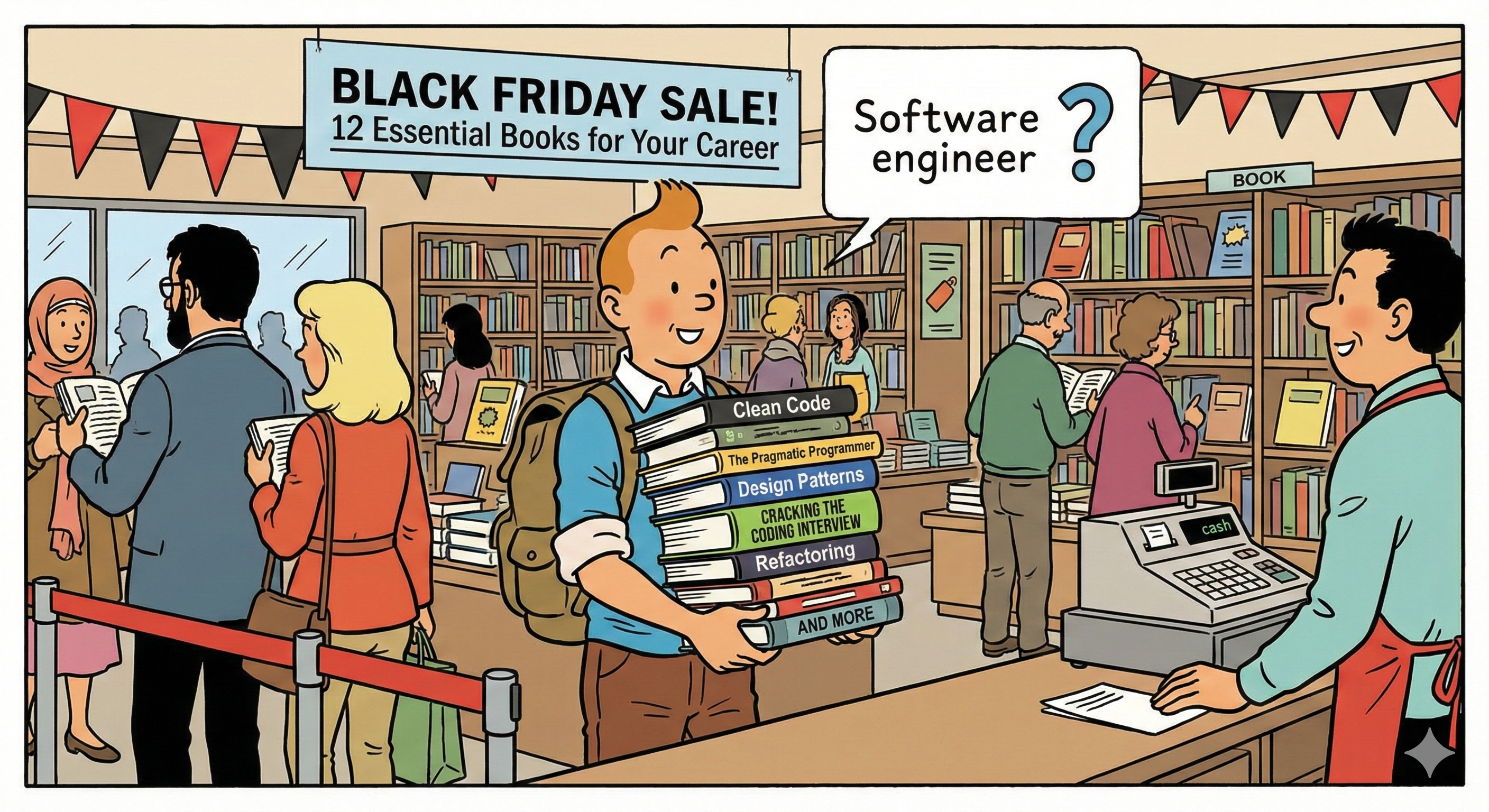
📚 Black Friday: 12 Books That'll Change Your Engineering Career
🎯 Why Books Still Matter (Even in the Age of AI)
In these days of AI, video tutorials, and short attention spans, I want to make a case for something that might seem old-fashioned: reading books.
As a professional software engineer, the best skills I've developed have come from two sources: deliberate practice and deep reading. Reading books requires sustained attention, and that deep focus gives you deep understanding. My most powerful "aha moments"—those revelations that fundamentally changed how I think about code, architecture, or teams—have come when reading books and suddenly seeing myself in a similar situation from my professional career.
I still believe that one of the best ways to learn is through books. This isn't nostalgia talking. It's a deliberate choice to fight against the trends pushing the human brain toward shorter attention spans and surface-level comprehension.
With Black Friday here, I wanted to create this guide to share book recommendations that have shaped my engineering journey. These aren't random picks—they're books I've either read entirely, partially, or have come highly recommended by people I trust. I've organized them into four categories that cover the full spectrum of what it means to be a professional software engineer:
- Architecture - Designing systems that scale
- Software Craftsmanship - Writing code that lasts
- Engineering Leadership - Building and leading teams
- Product & Process - Delivering adn value effectively
Let's dive in.
📖 The Essential Reading List
🏗️ Architecture
1. Building Microservices: Designing Fine-Grained Systems by Sam Newman

One of the definitive books on microservices architecture. Newman covers everything from the basics through integration patterns, splitting monoliths, deployment strategies, testing, monitoring, security, system design, the role of architects, and scaling services.
This is where I discovered the concept of Hexagonal Architecture—a gem that changed how I think about system boundaries and dependencies.
Personal connection: Sam Newman gave a talk at my company during the pandemic. Surprisingly, the main thing I remember is his balanced perspective: microservices aren't the answer for everything. Sometimes monoliths are perfectly fine.
Why it matters: Nowadays, microservices are everywhere. Sam Newman's book is a must-read for anyone who wants to understand the trade-offs and best practices of microservices architecture.
2. System Design Interview — An Insider's Guide by Alex Xu

This comprehensive guide to system design interviews comes in two volumes and features excellent diagrams and step-by-step breakdowns that are incredibly helpful for visual learners. Each chapter tackles real-world system design problems with practical solutions.
Opinion: Yes, this book is focused on interviews, not pure architecture theory. But here's the thing: behind each interview example lies genuine architectural design and valuable lessons. If you're preparing for a technical position, you'll almost certainly face a system design interview. This book bridges the gap between interview preparation and real architectural thinking.
Why it matters: The best way to learn architecture is through concrete examples. This book provides dozens of them, with clear explanations of trade-offs and decision-making processes.
3. Design Patterns: [Your Pick]

I'm leaving this one open-ended because there are several excellent books on design patterns, and the best one depends on your language and context. Whether it's the original Gang of Four, Head First Design Patterns, or a language-specific guide—having a solid understanding of design patterns is foundational.
Call to action: What's your favorite design patterns book? Drop your recommendation in the comments—I'd love to hear what worked for you!
Why it matters: Design patterns are the vocabulary of software architecture. They let you communicate complex ideas succinctly and recognize solutions to recurring problems.
🛠️ Software Craftsmanship
1. Clean Code: A Handbook of Agile Software Craftsmanship by Robert C. Martin
Robert C. Martin distills the best practices of writing clean code "on the fly" into principles, patterns, and practices that will make you a better programmer—but only if you work at it. The book challenges you to read code, think critically about what's right and wrong with it, and reassess your professional values and commitment to your craft.
Personal connection: This was one of the first books I read as an engineer. It opened my eyes to so many areas I hadn't considered. Reading someone so passionate about their profession was inspiring. I discovered that software is a craftsmanship and that we need to be proud of what we do.
Even though I don't fully agree with everything in the book (and it can be a bit dogmatic at times), the passion Martin brings is contagious. This book fundamentally changed how I view my work.
Why it matters: Clean Code teaches you that writing code is not just about making things work—it's about creating maintainable, readable, and professional software that you and others can be proud of.
2. A Philosophy of Software Design by John Ousterhout
Short, clear, and to the point, Ousterhout frames abstract concepts very clearly, attaches concise names to them, and shows their implications. The central thesis: good software design is about minimizing the complexity of a software system.
Opinion: I recently read this partially, and many chapters present opposite or clashing opinions to Clean Code. I love reading two books from experienced professionals showing different perspectives on the same topics. It helps me build and evolve my own thinking rather than dogmatically following one philosophy.
Why it matters: This book teaches you to think about complexity as the enemy and shows you practical techniques to combat it. The contrarian perspective to Clean Code forces you to think critically rather than accept received wisdom.
3. Beyond Legacy Code by David Scott Bernstein

This book approaches quality from a higher level than Clean Code—focusing on practices rather than just code. It's about good practices to extend the life of your code and create better software systems.
Personal connection: I read this in my early software engineering days. This is where I realized that as engineers, we have a responsibility not only to create quality code, systems, and platforms but also to help make this industry evolve beyond being called "an industry of amateurs." Software engineering is a young industry compared to others, and we have a duty to professionalize it.
Why it matters: Beyond Legacy Code isn't just about creating better software; it's about creating a better software industry. It elevates the conversation from tactical coding decisions to strategic professional responsibility.
👔 Engineering Leadership
1. The Software Engineer's Guidebook by Gergely Orosz

A comprehensive summary of career advice from someone who has traveled the typical software engineer career path: from engineer to senior to manager. It provides very useful advice on how to advance your career and be a great team player.
Opinion: Concepts like "own your career" are gold. This author also runs an excellent newsletter called The Pragmatic Engineer at pragmaticengineer.com that's worth subscribing to.
Why it matters: Most engineers stumble through their careers without a roadmap. This book gives you that map, with practical advice on navigating each stage from junior engineer to leadership.
2. Team Topologies by Matthew Skelton and Manuel Pais

Very useful for solving organizational and management problems you might encounter. Team Topologies provides specific organization design examples and frameworks for structuring engineering teams.
Opinion: This book taught me how important Conway's Law really is. Conway's Law states that "organizations which design systems are constrained to produce designs which are copies of the communication structures of these organizations." In simpler terms: your system architecture will mirror your team structure. Understanding this principle is crucial for anyone making architectural or organizational decisions.
Why it matters: Most books treat architecture and organization as separate topics. Team Topologies shows you they're two sides of the same coin. You can't design good systems without considering how your teams are organized.
3. Radical Candor by Kim Scott
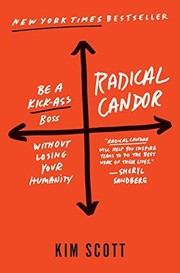
Provides clear and honest guidance on the fundamentals of leading others. The central framework: to be a good boss, you have to Care Personally and Challenge Directly at the same time. When you challenge without caring, it's obnoxious aggression. When you care without challenging, it's ruinous empathy. When you do neither, it's manipulative insincerity.
Opinion: If you're a manager with people reporting to you and you care about them, this book can help you build better relationships at work. It's a practical framework for the hardest part of leadership: giving honest feedback while maintaining trust.
Why it matters: Most management books are either too theoretical or too prescriptive. Radical Candor gives you a simple, memorable framework that you can actually apply in real situations.
🚀 Product & Process
1. User Story Mapping by Jeff Patton

User story mapping is a visual process that organizes user stories to create a holistic view of a user's journey and prioritize product development. It arranges stories on a two-dimensional grid: the horizontal axis represents the user's chronological steps, and the vertical axis shows different ways to complete each step and priority levels. The book also covers the controversial topic of how to split user stories.
Personal connection: This book is deep in my heart. I love the concepts behind the user story mapping practice—they embody the agile, user-centric principles that we all use every day. This is what product development should look like.
Why it matters: User Story Mapping transforms abstract requirements into a visual, shared understanding of the user journey. It's the bridge between "we need to build features" and "we need to deliver user value."
2. Leading Lean Software Development by Mary and Tom Poppendieck

The structure makes it very pleasant to read, mixing the presentation of lean concepts with case studies and short personal stories. The book shows how to apply lean manufacturing principles to software development. Mary and Tom are a married couple of engineers writing about this transformation.
Opinion: I love the examples they use. Like the story about how the Empire State Building was constructed—the tallest building in the world at the time—and how they met an impossible deadline using lean principles. These stories make abstract concepts concrete and memorable.
Why it matters: Lean thinking isn't just about eliminating waste—it's about optimizing for flow and value delivery. This book shows you how those principles translate to software.
3. The Little Book of Talent (or The Talent Code) by Daniel Coyle

This book presents the proposition that talent is nurtured and grown, not something you're born with. It helps you develop your talents to their full potential through deliberate practice.
Personal connection: My manager recommended this book to me. I found it very interesting and inspiring because many people think they can't do certain things because they weren't born with those skills. This book says the opposite—talent is built, not inherited.
Why it matters: In an industry obsessed with "10x engineers" and "natural talent," this book is a refreshing reminder that excellence comes from practice and learning. It's empowering for anyone who feels like they're "not a natural" at something.
🎁 Conclusion: Building Your Engineering Library
Black Friday is the perfect time to invest in your professional development. These twelve books represent years of accumulated wisdom from some of the best minds in software engineering. They've shaped how I think about code, architecture, teams, and product development.
But this list isn't complete—it's a starting point based on my journey and the recommendations of people I trust. Your turn: What books have shaped your engineering career? What's missing from this list? Drop your recommendations in the comments below.
Remember: in a world of fast information and AI-generated answers, books offer something unique—the space and depth to develop true understanding. They require attention, but they reward it with insights that stick.
Happy reading, and happy Black Friday shopping! 📚
PD: I did not include any links to any of these books, it´s for you to find the best price and buy them in the Black Friday sale.